


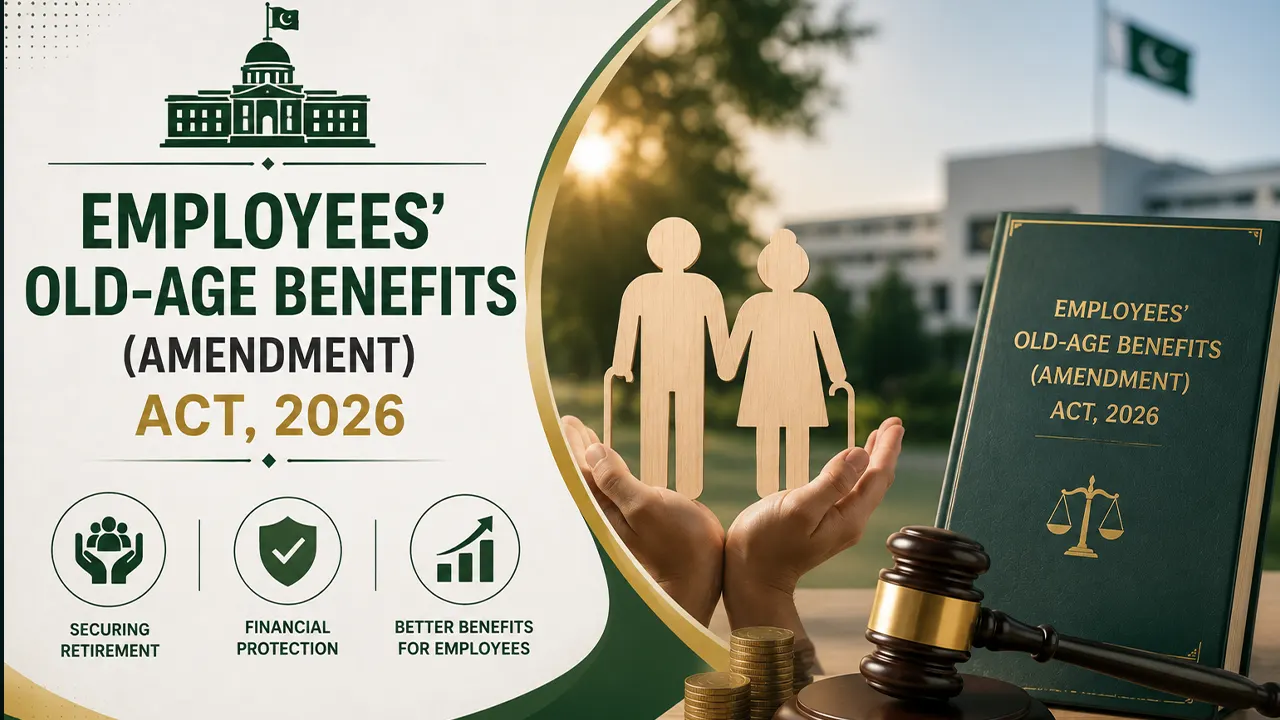
Employees’ Old-Age Benefits (Amendment) Act, 2026
Published On 25 Aug, 2026
Pakistan’s National Assembly has introduced the Employees’ Old-Age Benefits (Amendment) Act, 2026 to amend the Employees’ Old-Age Benefits Act, 1976 and update the authorities responsible for administering provisions related to old-age benefits in Pakistan.
The amendment mainly replaces references to the “Federal Government” with the “Prime Minister” or “Division concerned” in different sections of the Employees’ Old-Age Benefits Act, 1976, in line with earlier federal government directives on assigning appropriate authorities.
What Changed Under the New Law?
“Division Concerned” Defined
A new definition of “Division concerned” has been added to Section 2 of the Employees’ Old-Age Benefits Act, 1976.
Under the amendment, it means the division to which the business of the Act stands allocated.
Federal Government Powers Reassigned
The amendment replaces the words “Federal Government” with “Prime Minister” or “Division concerned” in several provisions of the Act.
These changes include:
• Section 7
• Section 8
• Section 8A
• Section 19
• Section 38
• Section 44
Prime Minister’s Authority Updated
In Section 7, the words “Federal Government” are replaced with “Prime Minister” in subsection (1).
Similarly, Section 8A is amended to replace “Federal Government” with “Prime Minister.”
“Division Concerned” Replaces Federal Government
In various provisions, the amendment substitutes “Federal Government” with “Division concerned.”
These changes apply to provisions under:
• Section 7
• Section 8
• Section 19
• Section 38
• Section 44
Why Was the Law Introduced?
According to the Statement of Objects and Reasons, the Employees’ Old-Age Benefits Act, 1976 was enacted to consolidate and rationalize the law relating to old-age benefits for people employed in industrial, commercial and other organizations across Pakistan.
The Federal Cabinet, in its meeting held on 8 September 2017, directed ministries and divisions to consult the Law and Justice Division and amend their respective Acts and Rules by replacing references to the “Federal Government” with appropriate authorities.
What Does the Amendment Aim to Achieve?
The legislation seeks to:
• Update the Employees’ Old-Age Benefits Act, 1976
• Define the term “Division concerned”
• Replace outdated references to the “Federal Government”
• Assign certain powers to the Prime Minister
• Assign other responsibilities to the relevant division
• Align the Act with the Federal Cabinet’s 2017 directive
• Rationalize the legal framework governing old-age benefits
Key Provisions of the Amendment
• The Employees’ Old-Age Benefits (Amendment) Act, 2026 is introduced
• The Employees’ Old-Age Benefits Act, 1976 is amended
• “Division concerned” is formally defined
• “Federal Government” is replaced with “Prime Minister” in specified provisions
• “Federal Government” is replaced with “Division concerned” in several other provisions
• Changes are made to Sections 7, 8, 8A, 19, 38 and 44
• The amendment implements the relevant Federal Cabinet directive
• The Act comes into force immediately
Pakistan’s National Assembly has introduced the Employees’ Old-Age Benefits (Amendment) Act, 2026 to update the administrative framework of the Employees’ Old-Age Benefits Act, 1976, clarify the relevant authorities, and replace references to the Federal Government with the Prime Minister or Division concerned where specified under the amended law.